What Does A Flat Tire Feel Like: Signs You Shouldn’t Ignore

What does a flat tire feel like? Recognize shaking, pulling, and thumping, plus learn how to stop safely before damage gets worse.
On a U.S. highway, city street, or rural road, a flat tire can feel like a steady pull, heavy steering, a rhythmic thump, or a loose, unstable ride. You may feel shaking through the steering wheel, seat, or floor. A slow leak may cause few clear signs at first, while a sudden loss of air can change how your car handles within seconds.
If you suspect a flat while driving, hold the wheel firmly, avoid hard braking, and ease off the gas. Keep the car stable, then move out of traffic when it is safe. Do not try to confirm the problem by swerving or making a hard stop.

What Does a Flat Tire Feel Like While Driving?
A flat tire often makes the car feel uneven, harder to steer, or less stable. The exact feel depends on which tire loses air, how fast the leak is, your speed, and the road.
Air pressure helps a tire support the car’s weight and hold its shape. When pressure drops, the tire bends more than it should. With severe air loss, it can no longer roll as designed.
Pulling or heavy steering
You may need more effort to keep the car straight. The steering may feel heavy, vague, or slow to respond.
A front tire that loses air can cause a pull toward the affected side. But the direction of a pull does not reliably identify the flat tire. Road slope, wind, alignment, and other faults can cause a similar feel.
Thumping, flapping, or shaking
A badly deflated tire may make a repeated thump or flap as it turns. You may feel that beat through the wheel, floor, or seat.
The sound may speed up as the car speeds up. Do not drive faster to test it. A thump can also signal tire damage even when the tire still holds air.
A loose or unstable rear end
A rear flat may feel less like a steering pull and more like a sway or wobble from behind. The car may seem unsettled as you hold your lane.
That sensation is a warning, not a diagnosis. Suspension faults and other tire problems can also make the rear of a car feel loose.
Little change at first
A slow leak may not feel like much at all. A tire can be low on air before it looks flat or causes a clear change in handling.
Run-flat tires can also mask some signs of air loss. Their reinforced design may support the vehicle for limited travel under specified conditions. That does not make a pressure warning safe to ignore.
Flat Tire Symptoms: What They May Mean
Use the signs below to decide how urgently to stop and check—not to diagnose the cause while moving.
| Sign | Possible explanation | Safe response |
|---|---|---|
| Sudden pull with a bang or fast change in handling | Rapid air loss or another tire failure | Stabilize the car, then slow and leave traffic safely |
| Repeated thump or flap | Severe deflation, tire damage, or another rotating-wheel fault | Stop in a safe place; do not keep driving to test it |
| Heavy or vague steering | Low pressure, steering trouble, or another fault | Reduce speed smoothly and arrange a safe check |
| Shaking through the seat or floor | Rear tire trouble, wheel damage, imbalance, or another fault | Stop safely if shaking is new, strong, or worsening |
| Tire-pressure warning with normal handling | One or more tires may be significantly low | Check pressure promptly in a safe place |
| Pulling with no noise or warning light | Low pressure, road slope, alignment, brakes, or another cause | Check tires first; seek service if the cause remains unclear |
No single sound or sensation proves that a tire is flat. A damaged tire can still contain air, and a low tire may cause no obvious shake.
Is it a flat tire or a blowout?
A flat tire is a tire with too little air to function properly. A blowout is a sudden, rapid loss of air. A blowout can leave a tire flat, but many flats develop slowly.
A blowout may begin with a loud pop or bang, followed by a pull, vibration, or flapping noise. Not every rapid air loss makes a loud sound.
Could it be a pothole or wheel problem instead?
Yes. A pothole can damage the tire, bend the wheel, or affect alignment. A tire belt problem, loose wheel hardware, or a worn suspension part may also cause shaking or thumping.
If the car feels wrong but the tire does not look flat, do not assume it is safe. A pressure check and a professional inspection may both be needed.

What to Do If You Think You Have a Flat Tire
Your first task is to keep control and reach a safer stopping place. Confirming which tire failed comes next.
NHTSA’s tire-blowout guidance emphasizes a firm grip, avoiding abrupt braking, and slowing gradually once the vehicle is stable.
1. Hold the wheel firmly
Keep both hands on the wheel and look where you want the car to go. Make small, smooth steering corrections.
Do not jerk the wheel toward the shoulder. A sudden lane change can make an unstable car harder to control.
2. Avoid hard braking
Do not slam on the brakes or abruptly lift off the accelerator. Ease off the gas as you keep the car steady.
Once the car is stable, slow gradually. Brake gently as needed to reach a safe stopping point.
3. Signal and leave traffic when safe
Choose a nearby parking area, rest area, or wide shoulder if you can reach it without losing control. Do not keep driving toward a distant exit just to avoid stopping.
Use your hazard lights to warn other road users when appropriate. After stopping, shift into Park—or follow your manual’s parking steps for a manual transmission—and set the parking brake.
4. Assess the location before getting out
A roadside tire check can be more dangerous than the flat itself. If you are close to moving traffic, on a narrow shoulder, or in poor visibility, call for help rather than starting a tire change.
There is no single safe choice about staying in or leaving the car in every roadside setting. Consider traffic, barriers, fire or smoke, and the risk of a collision. Call 911 if you are stranded in a travel lane or face immediate danger; follow the dispatcher’s instructions.
5. Check only when it is safe
From a safe position, look for:
- A collapsed or badly distorted tire.
- Cuts, bulges, torn rubber, or exposed cords.
- A damaged wheel.
- A nail, screw, or other object in the tread.
Do not pull out an embedded object. It may be slowing the leak. Do not crawl under the car or inspect the traffic-facing side while exposed to passing vehicles.
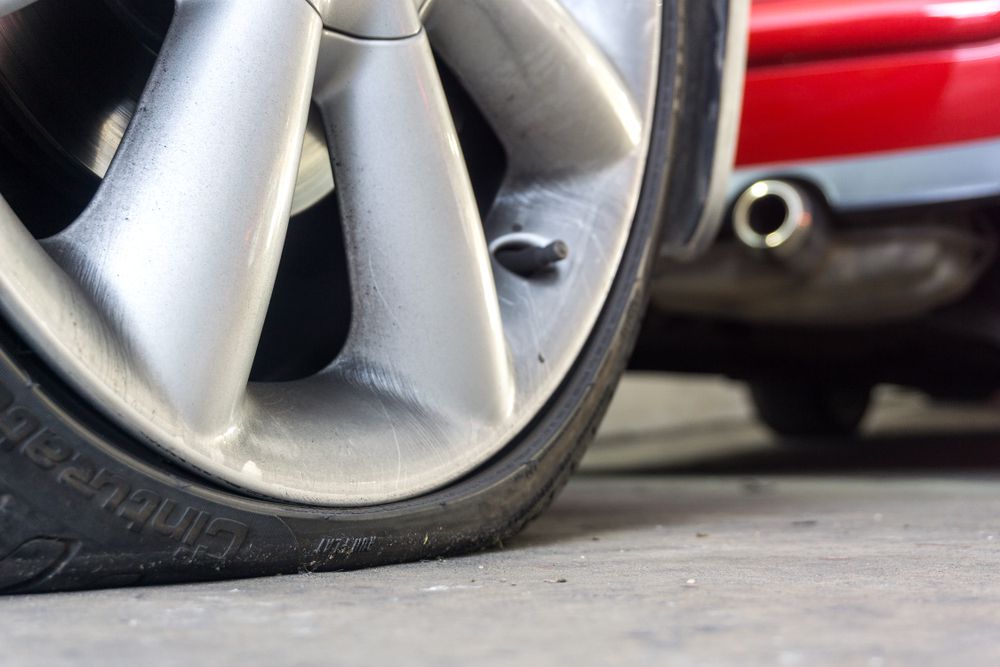
How to Confirm a Flat Tire Once You Are Safely Parked
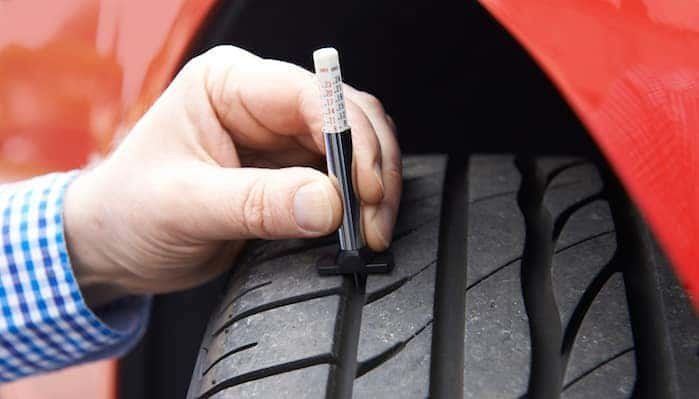
A tire-pressure gauge can confirm low pressure, but it cannot rule out tire damage. Use the gauge along with a visual check.
You will need a safe place to work, a suitable gauge, and the vehicle’s recommended tire pressures.
- Find the pressure label. On most U.S. passenger vehicles, it is on the driver’s door edge or door jamb. The owner’s manual also provides guidance.
- Check each tire. Remove the valve cap, press the gauge firmly onto the valve, and read the pressure in pounds per square inch, or psi.
- Compare with the vehicle specification. Front and rear pressures may differ. The number molded on the tire sidewall is not the vehicle’s recommended inflation pressure.
- Look for damage. A tire that has a bulge, exposed cords, or severe sidewall damage needs professional attention even if it holds pressure.
For routine checks, NHTSA defines “cold” tires as tires on a vehicle that has not been driven for at least three hours. Driving warms the tires and raises pressure. Do not let air out of a warm tire just to match the cold-pressure figure.
A normal-looking tire is not proof of correct pressure. Likewise, adding air is not proof that a punctured or previously flat tire is fit to drive.
If a tire will not hold air, has visible damage, or was driven while severely underinflated, use a suitable spare or arrange roadside service. A tire professional should assess whether it can return to service.

Can You Keep Driving on a Flat Tire?
Do not continue normal driving on a conventional flat tire. Driving on it can damage the tire and wheel and reduce control. There is no universal safe distance or speed for doing so.
If you are in an active traffic lane or another immediately dangerous spot, moving the shortest practical distance to a safer place may be necessary. Personal safety takes priority over saving the wheel.
Run-flat tires have model-specific limits
Some run-flat tires allow limited travel after air loss. The allowed speed and distance depend on the tire, vehicle, load, and damage.
Check the owner’s manual and the tire manufacturer’s instructions. Do not apply a run-flat limit from another vehicle, and stop if handling becomes unsafe.
A temporary spare has limits too
A compact spare is a short-term way to reach service. Follow the speed, distance, load, and installation instructions on the spare and in the owner’s manual.
Some vehicles also have restrictions on where a temporary spare may be fitted. Do not assume every spare fits every wheel position without checking.
Sealant is not a repair for every flat
A sealant-and-inflator kit may help with some small tread punctures. It cannot make a torn sidewall, damaged wheel, or badly damaged tire safe.
Follow the kit and vehicle instructions, including any pressure, speed, distance, and expiration limits. Tell the repair shop if you used sealant.

Common Mistakes That Make a Flat Tire More Dangerous
The main mistakes are ignoring early signs, trying to diagnose the fault at speed, and attempting repairs in an unsafe place.
- Waiting for the tire to look flat. A tire can be substantially underinflated without an obvious change in shape.
- Relying only on the TPMS light. The tire pressure monitoring system warns of significant underinflation; it does not replace pressure checks or detect every kind of tire damage.
- Assuming vibration means wheel balance. New or severe vibration can signal a more urgent fault.
- Inflating a visibly damaged tire. Added air does not restore damaged structure.
- Changing a tire beside fast traffic. Call roadside assistance when the site is not safe.
- Getting under a vehicle supported only by a jack. A tire-change jack is not a safe support for work beneath a vehicle.
Use the vehicle’s specified jack points and tire-change procedure. If the ground is soft, sloped, or unstable—or if you lack the right tools—stop and get help.
FAQs
Can cold weather make a tire feel flat?
Cold weather can lower tire pressure and trigger a pressure warning. Whether the handling changes depends on how low the pressure gets.
Check all tires against the vehicle’s cold-pressure specification. Do not dismiss a warning as “just the weather”; a leak may also be present.
Does a flat tire always trigger the TPMS light right away?
No. TPMS operation varies by vehicle, and the warning may not appear at the first sign of air loss. A sudden failure can affect handling before you notice a warning.
Treat a new pull, thump, or unstable ride as a reason to stop safely, even if the dashboard shows no alert.
Can a flat tire be repaired?
Sometimes. U.S. Tire Manufacturers Association guidance limits passenger and light-truck puncture repairs to qualifying injuries in the tread area, no larger than 1/4 inch, or 6 millimeters.
The tire must be removed from the wheel for an internal inspection. A proper repair fills the injury and seals the inner liner; an outside plug alone is not a complete repair. Sidewall damage or damage from driving flat can rule out repair.
Why does the car still shake after the tire is inflated?
Air pressure may not have been the only problem. The tire could have internal damage, the wheel could be bent, or another part could be at fault.
Do not keep driving on the assumption that the shake will go away. Arrange an inspection, especially if the vibration began suddenly or followed an impact.
Conclusion
A flat tire may feel like pulling, heavy steering, thumping, shaking, or a loose rear end. A slow leak may cause few clear signs, so feel alone cannot confirm that your tires are safe.
If the car suddenly feels wrong, stabilize it, slow smoothly, and stop somewhere safe. Then check pressure and visible damage—or call roadside assistance if traffic, location, or tire condition makes a check unsafe.
Sources and Research Scope
This guide draws on established U.S. tire-safety guidance. Live browsing was not available, so current page revisions, search results, and competing articles were not verified. No hands-on tire testing was performed.
- NHTSA: Tires — Tire pressure, TPMS, tire care, and blowout response.
- U.S. Tire Manufacturers Association: Tire Repair — Puncture repair limits, internal inspection, and proper repair methods.
- Your vehicle’s owner’s manual and tire placard — The controlling references for pressure, spare use, jack points, and vehicle-specific procedures.
Next-question gap map
The questions below are inferred next needs, based on the reader’s likely decisions. They are not verified search-demand findings. Competitor coverage is not checked because no live pages were inspected.
| Question | Reader stage and basis | Competitor coverage | Reader benefit and evidence | Priority and placement |
|---|---|---|---|---|
| What if the tire does not look flat? | During diagnosis; appearance may conflict with feel | Not checked | Avoids false reassurance; NHTSA pressure-check guidance | High; confirmation section |
| Should I change it on the shoulder? | After stopping; traffic may create a greater hazard | Not checked | Sets a safety boundary; situation-dependent roadside assessment | High; response steps |
| Can I drive to a tire shop? | After identifying a problem; travel limits differ | Not checked | Separates conventional tires, run-flats, and spares; vehicle and tire instructions | High; driving limits |
| Can it be repaired after being driven flat? | After recovery; hidden damage may change repairability | Not checked | Explains why an internal inspection matters; USTMA guidance | Medium; FAQs |