RAV4 Tire Pressure: Correct PSI And TPMS Guide

Check the right rav4 tire pressure for your model, understand TPMS alerts, and avoid common inflation mistakes. Read the guide for safer, smoother drives.
For a Toyota RAV4 sold in the United States, use the cold tire pressure printed on the Tire and Loading Information label inside the driver’s door opening. Do not use the maximum PSI on the tire’s sidewall as your target. The right pressure can vary by model year, tire size, and vehicle configuration.
If you found a chart that says every RAV4 needs 35 PSI, check your door label before adding air. A general chart cannot replace the label for your vehicle. This guide explains how to find the correct setting, check your tires, and deal with a tire pressure warning safely.

What Is the Correct Tire Pressure for a Toyota RAV4?
The correct RAV4 tire pressure is the front and rear cold PSI listed on your vehicle’s door label. Without the model year, original tire specification, and vehicle label, one number is not a reliable answer for every RAV4.
PSI means pounds per square inch. It measures the air pressure inside the tire. “Cold” describes the tire’s condition when you take the reading—not cold weather.
Use this table to choose the right source:
| What you need to know | Where to look | How to use it |
|---|---|---|
| Front tire pressure | Driver’s door Tire and Loading Information label | Set both front tires to the listed cold PSI |
| Rear tire pressure | The same label | Check the rear value rather than assuming it matches the front |
| Original tire size | Door label and owner’s manual | Compare it with the tires now fitted |
| Spare tire pressure | Owner’s manual and spare tire markings | Follow the specification for that spare |
| Tire pressure warning procedures | Owner’s manual for the exact model year | Use the procedure for your vehicle’s system |
Why the tire sidewall is not your pressure guide
The pressure molded into a tire’s sidewall relates to the tire’s limits and load rating. It is not Toyota’s recommended everyday pressure for your RAV4.
Toyota’s vehicle recommendation accounts for the vehicle and its specified tires. Setting your tires to the sidewall maximum can leave them overinflated for the vehicle’s intended use.
What if the door label is missing?
Check the exact model-year owner’s manual, then contact Toyota or a Toyota dealer if the specification remains unclear. Have your VIN and current tire size ready.
If the vehicle has nonstandard wheels or tires, ask a qualified tire shop to confirm the pressure requirements. A tire’s size and load rating matter; wheel diameter alone does not determine the right PSI.

How to Check and Set RAV4 Tire Pressure
Check all four road tires when cold, then adjust each one to its listed pressure. NHTSA defines cold tires as tires on a vehicle that has not been driven for at least three hours.
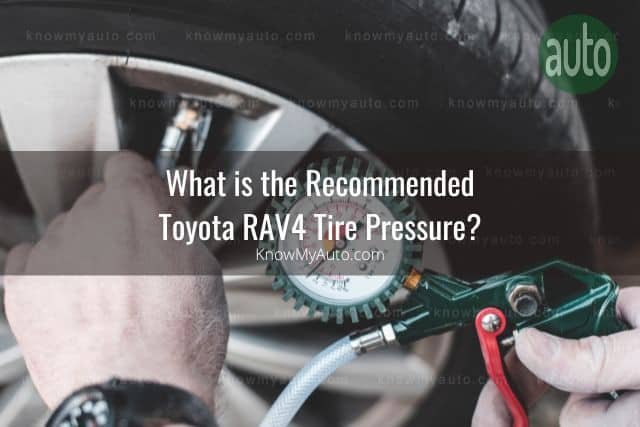
You will need a tire pressure gauge, access to an air pump, and the door-label specification. Choose a safe, level place away from traffic. Do not attempt roadside inflation where passing vehicles put you at risk.
- Read the door label. Note the front and rear cold-pressure values.
- Inspect each tire. Look for cuts, bulges, embedded objects, or a tire that appears much lower than the others.
- Remove one valve cap. Keep it where it will not roll away.
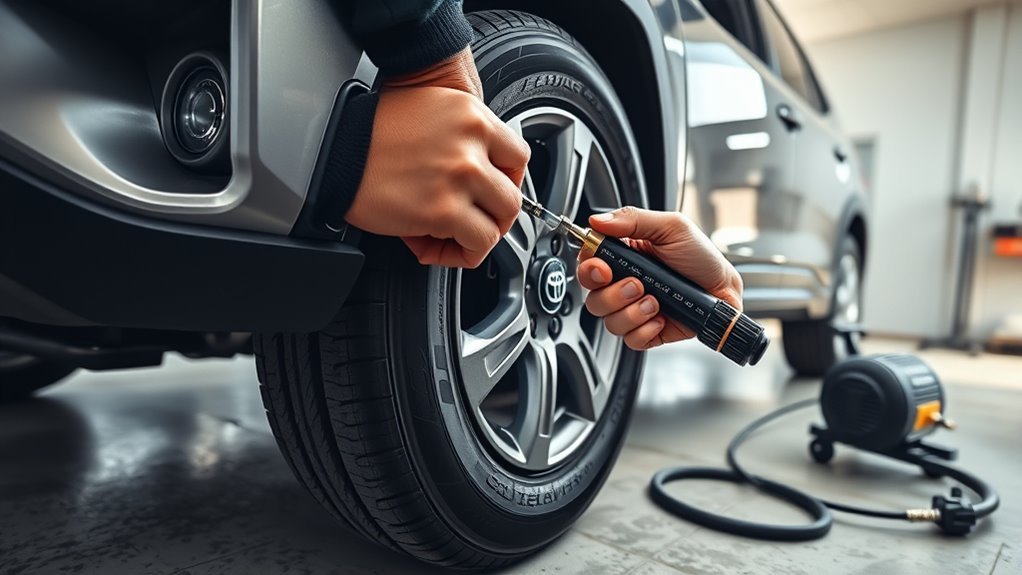
- Press the gauge firmly onto the valve. A steady reading without a continued hiss is the goal.
- Add air in short bursts if needed. Remove the air hose and check again with the gauge.
- Release a small amount if the cold tire is overfilled. Recheck until it matches the label.
- Replace the cap and repeat. Check all four tires, plus the spare if your vehicle has one.
For example, if a label specifies 35 PSI and a cold tire reads 30 PSI, that tire is 5 PSI below its target. This is an example, not a pressure recommendation for all RAV4s.
How to know the adjustment worked
Each cold tire should read its specified pressure when checked again. Listen for air escaping at the valve and make sure the caps are back in place.
The dashboard warning may take time or some driving to update. A gauge reading—not the warning light alone—is the best immediate check that you added the right amount of air.
What if the tire will not hold pressure?
If pressure drops again, arrange a tire inspection. A puncture, leaking valve, wheel damage, or a leak where the tire meets the wheel may be the cause.
Do not pull out a nail or screw before you have a repair plan. Removing it can make the tire lose air faster.

Cold vs. Hot Tire Pressure: Which Reading Counts?
Use a cold reading for routine pressure adjustments. Driving warms the tires and raises their pressure, so a reading taken after a trip may be higher than the door-label value.
Do not release air from a warm tire just to bring it down to the cold specification. Once the tire cools, it may be underinflated.
If you must check after driving:
- Treat the reading as a warm measurement.
- If the tire is below the listed cold pressure even while warm, add air rather than keep driving on a known low tire.
- Check and adjust again after the vehicle has been parked for at least three hours.
A clearly low or damaged tire needs attention at once. Do not wait for it to cool if waiting means continuing to drive on a tire that may be unsafe.
Why pressure falls in cold weather
Air pressure falls as the air inside a tire cools. That can trigger a warning on a cold morning even when there is no puncture.
The fix is to check all four tires cold and restore the label pressure. Do not ignore the warning just because it appeared after a weather change. If one tire keeps losing more air than the others, have it checked for a leak.

Why Is the RAV4 Tire Pressure Light On?
Check the tires before trying to clear the warning. The tire pressure monitoring system, or TPMS, alerts you to a pressure problem or a system fault. It does not replace regular checks with a gauge.
The warning pattern helps guide the next step:
| Symptom | Possible cause | Best first check |
|---|---|---|
| Tire pressure light stays on | One or more tires are low | Measure all four tires |
| Light appears after a cold night | Lower pressure as temperatures fall | Check and adjust when cold |
| One tire needs air again soon | A leak or tire damage | Arrange an inspection |
| Light remains on after inflation | Pressure still incorrect, delayed update, or system issue | Recheck with a gauge, then consult the manual |
| Light flashes for about a minute, then stays on | TPMS malfunction indication on vehicles using this warning pattern | Follow the manual and arrange service |
| Dashboard shows a blank or missing tire reading | Sensor communication or system issue | Check pressure manually and seek diagnosis if it persists |
A steady light does not tell you how safe the tire is to drive on. A gauge check and a visual inspection are still needed.
Can you drive with the tire pressure light on?
Do not decide based on the light alone. Check the tire’s condition and pressure first.
Do not keep driving on a flat tire or one with a bulge, exposed cords, or clear damage. Pull over safely if you feel strong vibration, hear a repeated thump, or notice a sudden change in steering. Use roadside help when needed.
If the tires look sound and are only slightly low, restore the specified pressure as soon as practical. Have a tire inspected if it keeps losing air.

How to Reset the RAV4 Tire Pressure Warning
Correct the pressure before using any reset or initialization function. A reset does not repair a leak or put air in a tire.
Toyota’s procedures vary by model year and equipment. Depending on the vehicle, the manual may describe a physical switch, a vehicle-settings menu, initialization, or sensor registration. These terms do not all mean the same thing.
Follow this order:
- Check all four tires cold.
- Set them to the door-label pressures.
- Look up the tire pressure warning section in your exact owner’s manual.
- Complete only the procedure that applies to your vehicle.
- Follow any stated driving or waiting conditions.
- Seek diagnosis if the warning remains or returns.
Do not use a generic online button sequence without checking the manual. On systems that use pressure initialization, starting the process with incorrect tire pressures can establish an incorrect reference.
After wheel or sensor work, the vehicle may need a separate sensor-registration procedure. A tire shop or Toyota service department can identify what the system requires.

Do Tire Size, Heavy Loads, or a Spare Change the Answer?
Changes to the tires or vehicle load can require more than a routine pressure check. Keep the vehicle’s tire, wheel, and load limits in view rather than adding air by guesswork.
Different tire sizes or replacement wheels
For a normal replacement that meets Toyota’s requirements, the vehicle placard remains the starting point. If the replacement changes the size, construction, or load specification, ask a qualified tire professional to verify the setup.
Do not assume larger wheels need more PSI. Do not assume a higher tire load rating lets the RAV4 carry more weight than Toyota allows.
Passengers, cargo, and towing
Stay within the limits on the vehicle’s labels and in the owner’s manual. If Toyota gives a specific pressure instruction for your use case, follow it.
Adding air does not increase the vehicle’s rated payload or towing capacity. Pressure is only one part of safe loading.
Spare tire pressure
Check the spare if your RAV4 has one. A compact temporary spare can require a much different pressure from the road tires.
Do not assume the spare uses the same PSI or that TPMS monitors it. Check its pressure and follow its speed and distance limits before relying on it.

Common RAV4 Tire Pressure Mistakes
The most useful habit is simple: check cold, use the door label, and recheck a tire that loses air. Avoid these common errors:
- Using a universal year chart. A chart may not account for your exact vehicle or tire specification.
- Inflating to the sidewall maximum. That is not the vehicle’s routine target.
- Bleeding air from hot tires. The tires may become underinflated once cool.
- Checking only the tire that looks low. A tire can be underinflated without looking flat.
- Waiting for TPMS to do every check. NHTSA recommends checking tire pressure at least once a month.
- Repeatedly resetting the warning. A returning warning needs a pressure check or diagnosis.
- Ignoring a slow leak. Repeated loss of air calls for an inspection, not endless top-ups.
Check tire pressure before a long trip as well. It is easier to find a problem in your driveway than on a freeway shoulder.
RAV4 Tire Pressure FAQs
Can I use the dashboard reading instead of a tire gauge?
A dashboard display is useful for spotting changes, but it may not update at once. Use a gauge when setting cold pressure and when confirming a warning.
Should I add extra air before a long highway trip?
Do not add an arbitrary amount. Set the tires cold to the vehicle’s specified pressure and follow any applicable instructions in the owner’s manual.
Does nitrogen change the recommended PSI?
No. The recommended pressure remains the same whether the tire contains ordinary air or nitrogen. You still need to check it regularly.
What if two gauges give different readings?
Repeat both checks with a firm seal at the valve. If the difference persists, compare them with a reliable shop gauge before making a large adjustment. Avoid averaging readings from gauges that may be inaccurate.
Can a tire need repair even if it stays inflated overnight?
Yes. A slow leak may take longer to show up, and some damage is not clear from a pressure reading. Have recurring pressure loss, bulges, cuts, or new vibration checked by a qualified tire professional.
Sources and Research Scope
The safety guidance in this article follows U.S. tire-safety guidance and Toyota’s model-specific documentation framework. Live browsing was not available for this draft. Current competing pages and individual RAV4 manuals were not inspected, so this guide does not present an unverified year-by-year PSI chart or a universal reset sequence.
Primary references for checking your vehicle’s requirements are:
- NHTSA Tires: cold-pressure checks, vehicle-label guidance, tire care, and TPMS limitations.
- Toyota Owners Manuals: model-specific pressure specifications, spare-tire instructions, and warning-system procedures.
The following next-question map records useful follow-up needs. These are inferred from the task, not verified search-demand findings. Competitor coverage was not checked.
| Next question | Reader stage and basis | Reader benefit | Answer evidence | Priority and placement |
|---|---|---|---|---|
| Which PSI applies to my exact RAV4? | Before inflation; configuration can change the answer | Avoids a wrong universal setting | Vehicle label and exact manual | High; opening and pressure table |
| Should I release air after driving? | During a check; warm readings can confuse | Prevents underinflation after cooling | NHTSA cold-pressure guidance | High; cold vs. hot section |
| Why does the light return? | After inflation; pressure may fall again | Helps separate leaks from system faults | Gauge checks, manual, professional diagnosis | High; troubleshooting section |
| Does a reset fix low pressure? | After a warning; reset procedures can be misused | Prevents masking an unresolved problem | Exact Toyota owner’s manual | High; reset section |

Conclusion
The right RAV4 tire pressure is the cold PSI on your vehicle’s driver-door label, not a universal number from a chart. Check all four tires with a gauge, use the correct front and rear values, and check the spare if fitted.
Start with the label today. If a tire keeps losing air or the warning remains after the pressures are correct, arrange an inspection rather than repeatedly resetting the system.