Do Flat Tire Repair Kits Work: The Truth About Quick Fixes

So, do flat tire repair kits work? Learn when they help, which punctures they can fix, and when professional repair is the safer choice.
Yes, flat tire repair kits can work—but only for certain punctures, and most roadside kits provide a temporary fix. For drivers in the United States, a sealant-and-inflator kit may help restore pressure after a small tread puncture. It will not fix a torn sidewall, a damaged wheel, or every tire that has been driven flat.
The key is knowing what “repair” means. A kit may get your car to a tire shop. A proper, lasting repair requires the tire to come off the wheel for an inspection and, when the damage qualifies, a repair that seals both the puncture and the inner liner.
If you are stopped on a highway shoulder now, put safety first. Do not work beside moving traffic. Call roadside assistance if you cannot reach the tire from a safe place.

Which Types of Flat Tire Repair Kits Work?
Flat tire kits work in different ways, so the type of kit matters as much as the hole. A spray can, an inflator kit, and a plug kit are not the same tool.
| Kit type | How it works | Where it may help | Main limit |
|---|---|---|---|
| Sealant and compressor | Adds liquid sealant and pumps air into the tire | A small puncture in the tread, within the kit’s limits | Usually a temporary mobility aid |
| Aerosol tire inflator | Adds sealant and some inflation gas | Certain small leaks, as listed on the label | May not restore enough pressure for the tire |
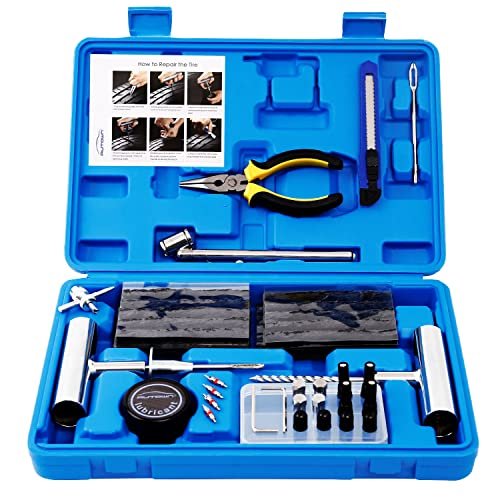
| External plug kit | Pushes a repair string or plug into the hole from outside | Some accessible tread punctures | Does not allow inspection of the tire’s interior |
| Internal combination repair | Fills the puncture path and seals the inner liner | An eligible puncture in an otherwise sound tire | Requires tire removal and proper repair tools |
Sealant kits: a temporary way to get moving
Liquid sealant coats the inside of the tire. When air escapes through a small hole, the sealant can collect at the leak and help close it. The compressor restores the air pressure needed to support the vehicle.
This works only if the tire, puncture, and kit meet the stated limits. A compressor cannot overcome every leak, and sealant cannot rebuild torn rubber or damaged tire cords.
Plug kits: holding air does not prove the tire is safe
An external plug may stop a leak. But it cannot show whether driving with low pressure harmed the tire from within.
The U.S. Tire Manufacturers Association’s tire repair guidance calls for removing the tire from the wheel, inspecting it, filling the injury, and sealing the inner liner. A plug alone or a patch alone does not meet that repair procedure.
The useful distinction is temporary mobility versus a completed tire repair. Do not treat the two as interchangeable.

When Will a Tire Repair Kit Work—and When Will It Fail?
A kit is most likely to help when the damage is small, lies within the repairable tread area, and has not caused internal harm. Damage near the sidewall, a large opening, or a tire driven flat changes the answer.
Use this table to choose the next step, not to diagnose hidden damage.
| What you find | Is a roadside kit a reasonable option? | Next step |
|---|---|---|
| Small nail or screw puncture in the tread | Possibly, if the kit permits it | Follow the kit instructions, then seek an inspection |
| Hole in the shoulder or sidewall | No | Use an approved spare or call roadside assistance |
| Large cut, tear, or blowout | No | Arrange a spare or tow |
| Bent or cracked wheel | Not a reliable fix | Have the wheel and tire inspected |
| Leak at the valve stem | Not reliably | Repair or replace the faulty valve components |
| Tire pulled away from the wheel’s bead seat | No ordinary roadside sealant fix | Get professional help |
| Tire driven flat or severely underinflated | Hidden damage may rule out repair | Have it removed and inspected |
| Tire with a bulge, exposed cords, or visible separation | No | Replace it; do not attempt a kit repair |
What does the 1/4-inch puncture limit mean?
For eligible passenger and light-truck tires, USTMA guidance limits puncture repairs to injuries no larger than 1/4 inch, or 6 millimeters, within the repairable tread area. The tire must also pass an internal inspection.
That is a professional repair limit—not a promise that every emergency kit can seal a hole that size. Your kit may have a smaller limit.
Location matters, too. A small hole near the shoulder can be outside the repairable area. A tire technician must assess the injury’s full path, not just the visible entry point.
Why does driving flat matter?
A tire’s sidewalls flex as the wheel turns. With too little air, that flex can damage the tire’s structure and generate excess heat.
A kit may make that tire hold air again without fixing the damage. Successful inflation is not proof that a tire is safe to drive.
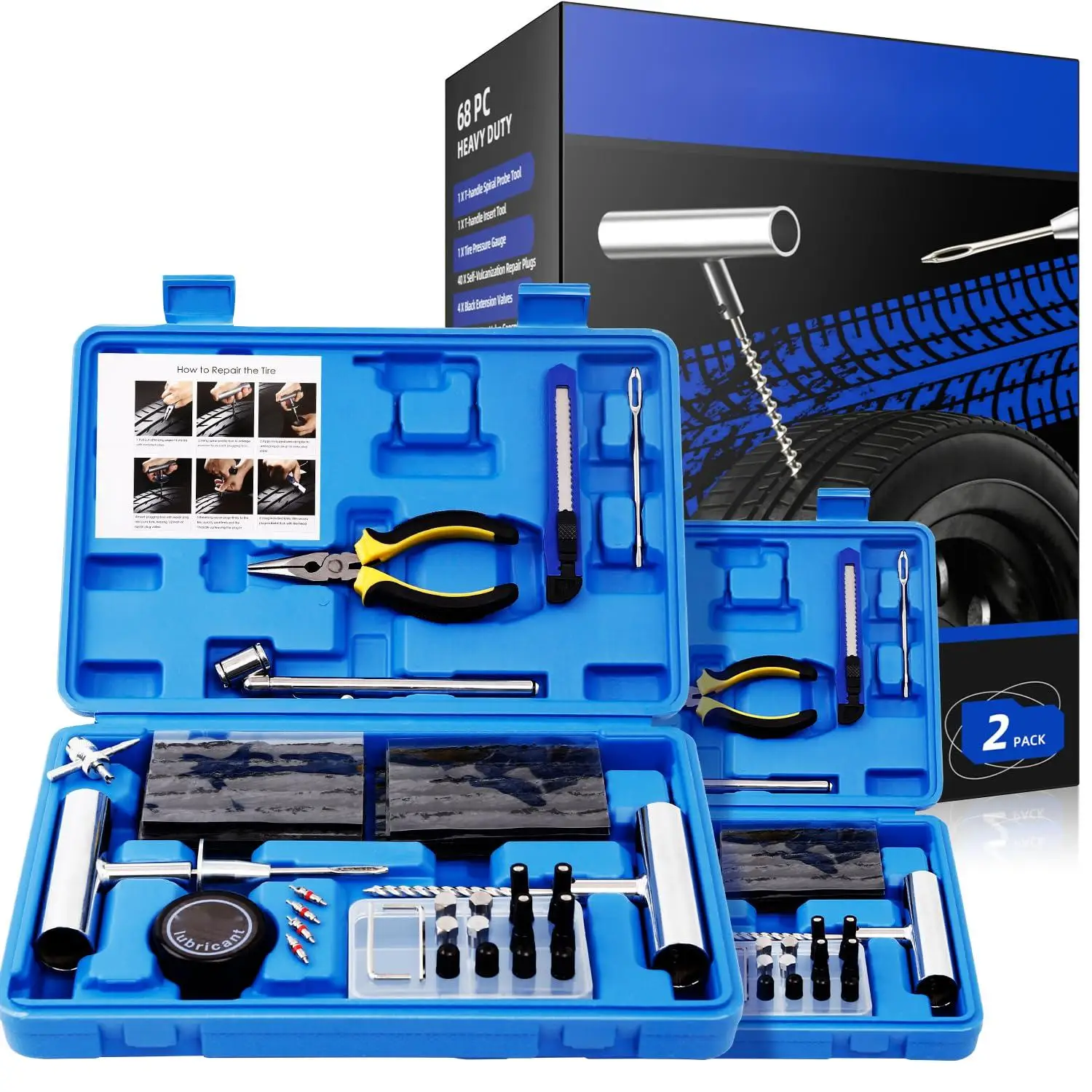
How to Use a Flat Tire Repair Kit Safely
Use a kit only after checking that the stopping place, tire damage, and kit instructions allow it. Vehicle-supplied systems can differ, so the owner’s manual takes priority over a generic sequence.
Before you start, have the kit instructions, a pressure gauge if one is not built in, and the vehicle’s recommended tire pressure. The correct pressure is usually on the driver’s door-jamb placard—not the maximum pressure molded into the tire’s sidewall.
1. Make the scene safe
Stop as far from traffic as you safely can. Turn on the hazard lights, select Park or the appropriate gear, and set the parking brake.
If the tire faces moving traffic or the car is in an unsafe position, call roadside assistance. A repair kit is not worth the risk of being struck.
2. Check the tire and the kit
Look for a torn sidewall, a bulge, wheel damage, or a tire that has come off its bead seat. Do not attempt a sealant repair if these are present.
Check the sealant’s use-by date, operating temperature range, and compatibility with the vehicle and tire. Confirm that the compressor’s power source is suitable.
3. Follow the exact connection sequence
Connect the sealant bottle, hose, compressor, and valve as directed. Some systems inject sealant through the compressor; others use a separate step.
Do not assume a nail or screw should be pulled out. Removing it can make the leak much larger. Follow the kit’s instructions.
4. Inflate within the stated time limit
Inflate toward the pressure specified by the vehicle and kit instructions. Watch the gauge and observe the compressor’s duty-cycle limit.
If the tire cannot reach the kit’s minimum required pressure within its stated time, stop. Do not keep running the pump in the hope that the tire will eventually seal.
5. Drive only if the instructions permit it
Some sealant systems require a short drive to spread the sealant, followed by another pressure check. Others have a different procedure.
Follow the kit’s exact speed, distance, and recheck instructions. Do not borrow limits from another product.
6. Recheck pressure and arrange an inspection
If pressure falls below the kit’s allowed threshold, stop in a safe place and call for help. Do the same if the vehicle shakes, pulls, or makes an unusual noise.
If pressure holds, travel only as the instructions allow and go to a tire shop promptly. Tell the technician that sealant is inside the tire.

How Far Can You Drive After Using a Repair Kit?
There is no single safe distance or speed for all tire repair kits. The limits printed on your kit and in your owner’s manual control.
A limit often quoted online—such as 50 mph—may apply to one system and not another. The same is true of mileage limits. These numbers are restrictions under stated conditions, not a guarantee that a damaged tire will remain usable.
Before driving, find all four of these details:
- The minimum pressure required before moving.
- The maximum permitted speed.
- The maximum permitted distance.
- The required pressure-recheck interval.
If the instructions are missing or unreadable, do not invent a limit. Consult the vehicle or kit manufacturer, or arrange roadside assistance.

Can a Tire Be Permanently Repaired After Using Sealant?
Sometimes. Sealant use does not, by itself, tell you whether the tire can be repaired. The damage, tire condition, sealant product, and applicable manufacturer guidance all matter.
A technician needs to remove the tire, inspect its interior, and assess whether the puncture meets repair criteria. A small tread puncture may qualify. A sidewall injury, internal damage from running flat, or an unsuitable previous repair may not.
A proper repair addresses two separate paths:
- Through the tread: The puncture channel needs to be filled.
- Through the inner liner: The tire’s air-retaining layer needs to be sealed.
A one-piece combination repair can perform both functions. Approved two-piece methods can also do so.
Bring the sealant container or a photo of its label to the shop. This helps the technician identify the product and its cleanup instructions. Some shops may decline certain sealant-contaminated tires, so ask before making a trip.

Repair Kit, Spare Tire, or Roadside Assistance?
A repair kit suits a narrow problem: a qualifying small puncture in a tire that remains structurally sound. A spare covers more types of tire damage, while roadside assistance is the right choice when the location or damage makes roadside work unsafe.
| Option | Best fit | Key trade-off |
|---|---|---|
| Sealant-and-inflator kit | A small, eligible tread puncture | Limited damage coverage; temporary use |
| Vehicle-approved spare | A flat that cannot be sealed, with a safe place to change it | Requires safe lifting and installation |
| Roadside assistance or towing | Unsafe location, major damage, or failed kit attempt | Requires waiting for service |
A compact spare has its own speed, distance, inflation, and vehicle-use limits. On some vehicles, the spare’s permitted axle position also matters. Check the owner’s manual.
For all-wheel-drive vehicles, ask about tire-size and tread-depth requirements before replacing only one tire. The acceptable difference depends on the vehicle manufacturer.
A kit can be a useful backup, but it is not a full substitute for a spare in every situation.
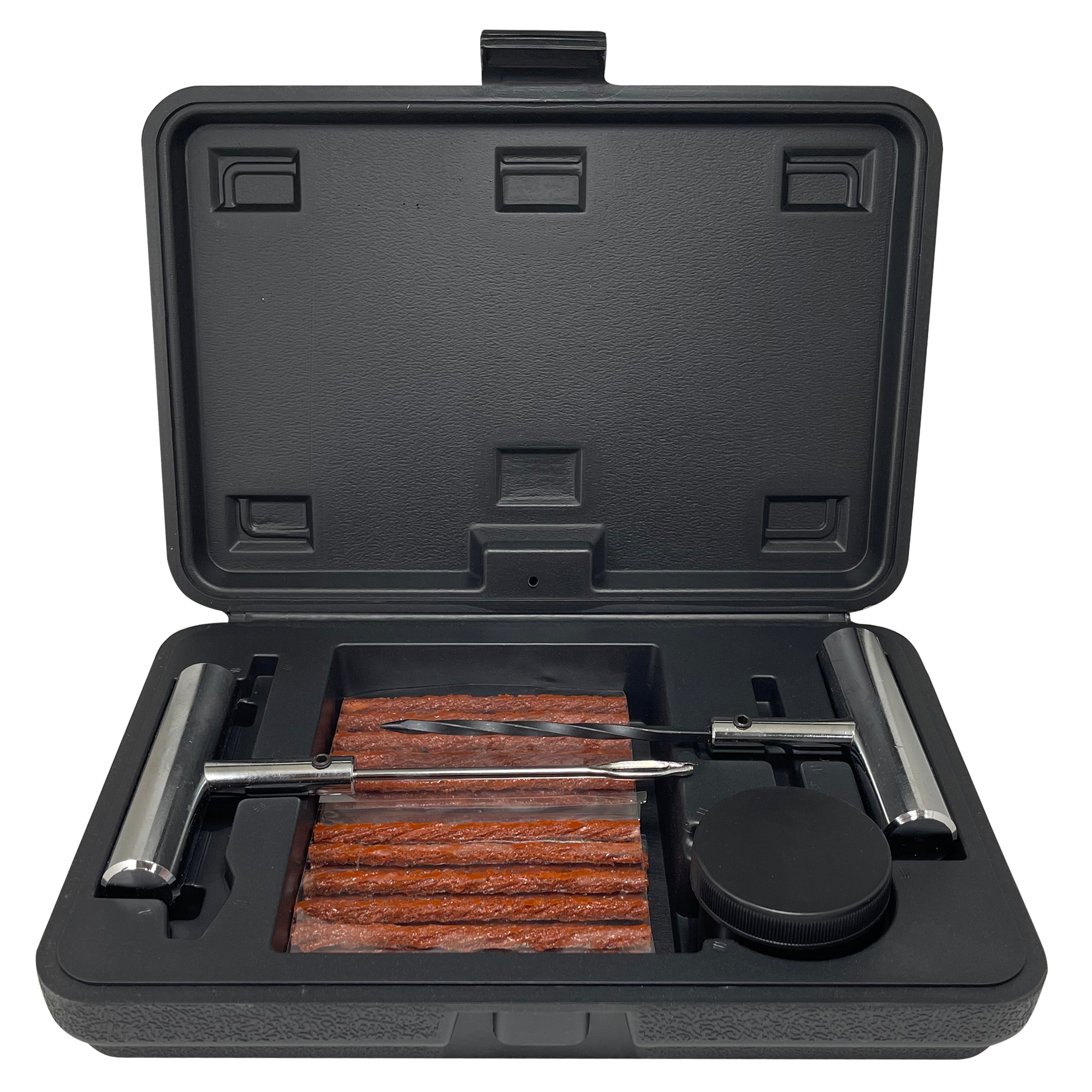
Common Mistakes That Make Tire Kits Less Useful
The biggest mistake is treating a tire that holds air as a tire that has passed inspection. A temporary seal hides neither structural damage nor the need for a proper repair.
Avoid these other errors:
- Using sealant on sidewall damage. A small sidewall hole is still outside standard puncture-repair guidance.
- Ignoring a falling gauge reading. Repeated air loss means the attempt has not produced a stable result.
- Overheating the compressor. Follow its run-time and cool-down limits.
- Using the sidewall’s maximum pressure as the target. Start with the vehicle placard and follow the kit procedure.
- Mixing sealant products. Compatibility and performance are not established simply because both products are labeled for tires.
- Leaving the kit unrestocked after use. A used bottle or missing hose can turn the next flat into a tow.
- Continuing normal driving after a temporary fix. Arrange an inspection promptly, even if the tire feels normal.
The National Highway Traffic Safety Administration’s tire safety guidance explains why correct inflation, condition checks, and vehicle-specific tire information matter. A repair kit does not replace those checks.

FAQs About Flat Tire Repair Kits
Will tire sealant damage the TPMS sensor?
Compatibility varies. Some products are labeled for use with tire pressure monitoring systems, but that does not establish compatibility with every sensor or eliminate the need for cleanup.
Check the kit and vehicle guidance. Tell the tire shop which product you used so the valve and sensor can be inspected.
Do tire repair kits expire?
Sealant bottles commonly have a printed use-by date. Replace the sealant as directed, even if the bottle is unopened.
Also check hoses, seals, and the compressor. A working pump does not make expired sealant reliable.
Do sealant kits work in freezing weather?
Only within the product’s stated temperature range. Cold can affect sealant flow and compressor operation.
Use the kit’s storage and operating instructions. Do not heat a bottle or aerosol can with a flame or another improvised heat source.
Can you reuse a sealant bottle after a repair?
Do not assume so. Many vehicle-supplied bottles are intended for a single repair event and need replacement afterward.
The compressor may remain reusable. Check whether the hose or other parts also need replacement or cleaning.
Why is the tire-pressure light still on after using a kit?
The tire may still be underinflated, another tire may be low, or the vehicle may require a specific monitoring or reset procedure. A sensor or system fault is another possibility.
Check all tire pressures with a gauge first. Do not reset the warning simply to turn the light off while the pressure remains low.
Evidence and Coverage Notes
This guide is an informational synthesis, not a hands-on kit test. Live browsing was unavailable, so current competing pages, search results, and individual product manuals were not inspected. No kit-specific success rate, price, speed limit, or mileage claim is made.
The primary U.S. reference points are USTMA’s puncture-repair guidance and NHTSA’s tire-safety guidance, linked above. For a specific vehicle or kit, its current manual is needed to confirm compatibility and operating limits.
The next-question map below records inferred reader needs—not verified search demand. Competitor coverage remains not checked.
| Next question | Reader stage and basis | Competitor coverage | Reader benefit and evidence needed | Priority and placement |
|---|---|---|---|---|
| Does holding air mean the tire is safe? | After use; inferred from the difference between sealing and inspection | Not checked | Prevents false reassurance; USTMA repair guidance | High; damage limits |
| What if the compressor cannot reach pressure? | During use; inferred failure condition | Not checked | Defines when to stop; exact kit manual required | High; use sequence |
| Can a shop repair a sealant-filled tire? | After use; inferred next repair decision | Not checked | Avoids assuming repair or replacement; inspection and manufacturer guidance | High; permanent repair section |
| What needs replacement after using the kit? | After use; inferred readiness need | Not checked | Restores the kit for the next flat; product instructions required | Medium; FAQs |

Conclusion: Do Flat Tire Repair Kits Work?
Yes—for some small tread punctures, under the kit’s stated conditions. Most consumer roadside kits are a way to regain limited mobility, not proof that the tire has received a safe, lasting repair.
Check the damage first. Follow the exact pressure, speed, and distance limits. If the tire will not hold pressure, has sidewall damage, or may have been harmed by driving flat, use an approved spare or call roadside assistance. Then have a qualified tire technician inspect it.